 HOME
HOME BUSINESS DIRECTORY
 CLASSIFIEDS
 CALENDAR

 NEWS
NEWS SPORTS
 OPINION
 OBITUARIES


Crescent Valley Town Advisory Board meeting By Lisa J. Wolf
The Crescent Valley Town Advisory Board met on January 7, 2026, at 5 p.m., covering topics ranging from public safety and infrastructure to a detailed discussion regarding water capacity fees.
Public Safety and Community Infrastructure
Public comment opened with safety concerns regarding Highway 306. Darcey Winkelkotter advocated for a crosswalk, noting that children cross the highway for school daily. She suggested a stop sign with blinking pedestrian lights to increase visibility. Public Works Director Jeb Rowley noted the board lacks the authority to implement this directly but could steer the request to the NDOT district.
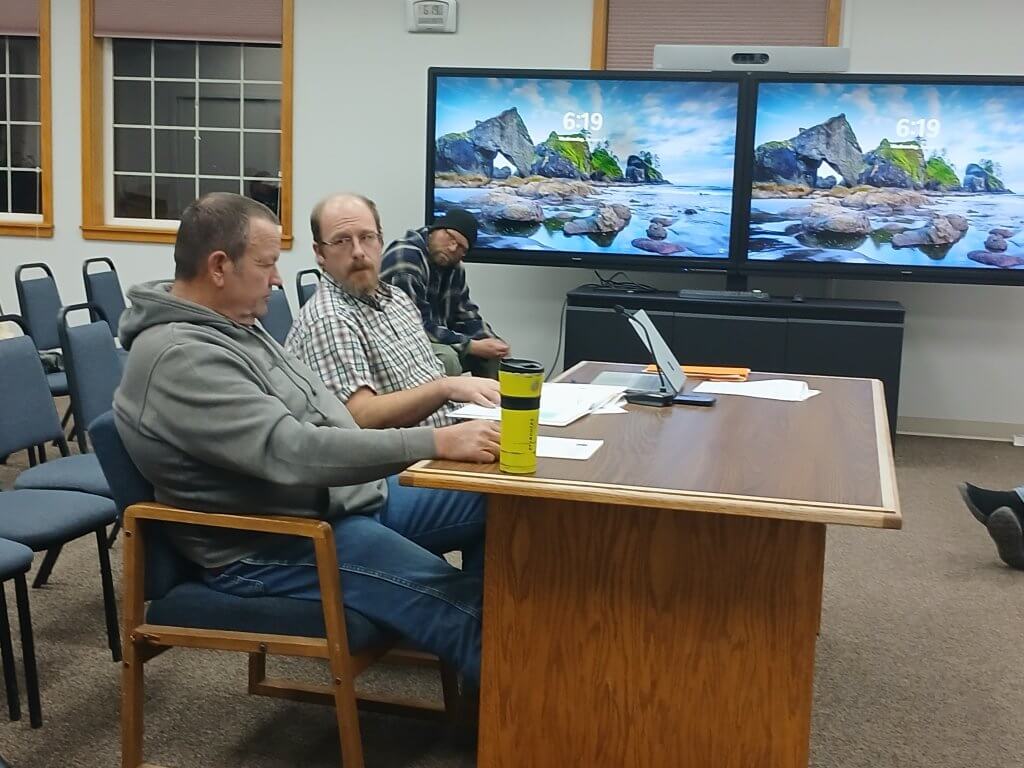
Dale Kersey, Jeb Rowley and Marcial Evertsen discuss water fees at the CVTAB meeting.
Vickie McCanna raised concerns about lighting, stating that many lights are out around the school and throughout town, leaving students to walk to bus stops in the dark. Board Secretary Christina Tucker advised that light poles have identification numbers and if residents provide those numbers, she can contact NV Energy directly. Vice Chair Jeremy Rice suggested budgeting for additional lights in the future.
Sheriff Miles Umina presented the December and 2025 figures, highlighting proactive measures by his deputies. He noted that Deputy William Hoggard had recently conducted traffic stops as early as 3:30 a.m., aiming to “change behavior” and keep drivers on their toes. Umina also reported that new dashcams have been delivered and are awaiting installation. These cameras will allow him to view active incidents live, providing an “overall view to protect my guys and to protect the community.” Regarding the upcoming budget season, Umina emphasized that the department is “cutting out bloat.”
Fire and EMS Updates
Speaking as Fire Chief, Rice reported that six members are undergoing HAZMAT awareness training. He is exploring additional classes, including response training for electric battery fires and railroad HAZMAT incidents.
Rice revealed that a new rail line is in the planning stages, projected to be constructed a mile or two east of Highway 306. The line, running from Beowawe to Control 1 near the Nevada Gold Cortez underground mine, is expected to significantly reduce ore truck traffic on Highway 306. Rice emphasized the need for emergency services to stay informed on the project’s progress to map crossings and access points.
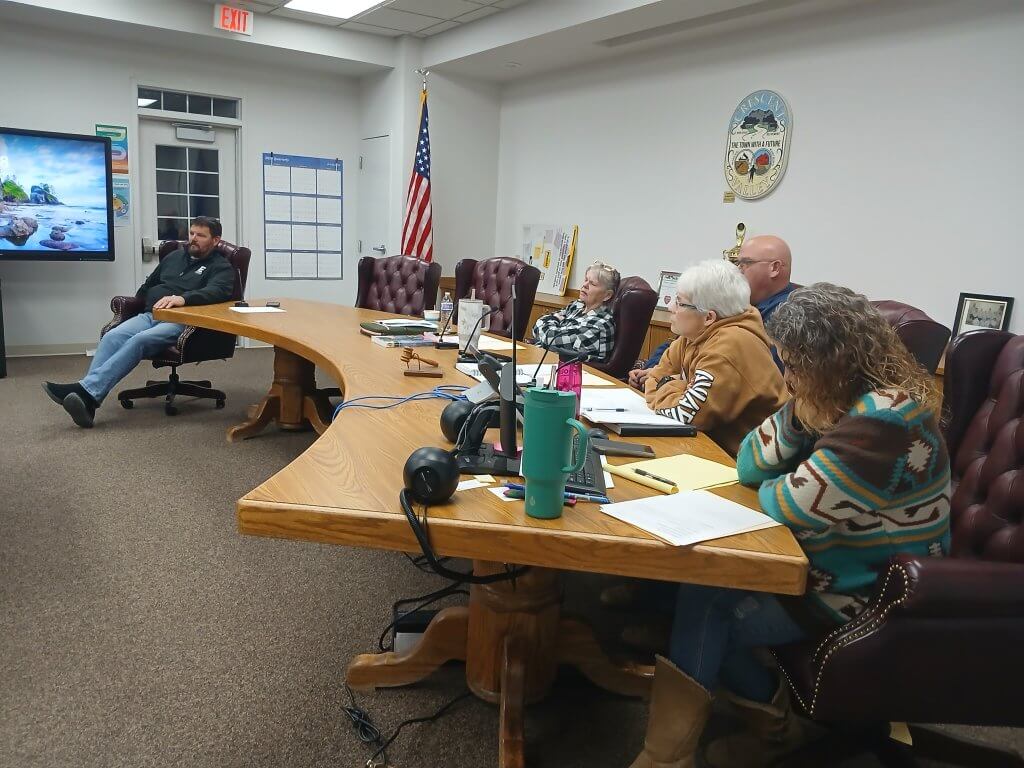
Regarding equipment, Rice noted that next year’s budget includes a specialized tarp system for electric battery fires, designed to smother the vehicle while a sprayer operates underneath. Incident numbers remained low, with only a few accidents and controlled burns reported in December and January.
Administrative Updates
Rowley informed the board of upcoming internal discussions regarding capital outlay to determine the division of labor between Public Works staff and contractors for the year. Tucker reported that exercise equipment for the CV park has been ordered, with shipment expected in March. Additionally, the Crescent Valley lay-down yard is now open for trash disposal from Friday through Sunday from 3:30 to 4:00 p.m.
Commissioner Mike Schoenwald provided a synopsis of the January 6 Commission meeting, noting efforts to streamline septic system permitting through the Central Nevada Health District and Public Works. Regarding the ambulance service contract with MedEx, Rice reported it is currently under legal review at the District Attorney’s office and should appear before the commissioners soon.
Water Capacity Fees
The bulk of the meeting focused on a detailed discussion regarding water connection costs, following concerns expressed by resident Dale Kersey at the previous meeting. Rowley attended in person to address the $9,920 capacity fee for a two-inch water service.
Rowley provided a history of the county water systems, explaining the 2022 consolidation under Title 20. He noted that the water systems in Eureka Town, Devil’s Gate, and Crescent Valley are technically “underwater” regarding revenue versus expenses.
“A utility fund or enterprise fund is intended to apply to the customers of that system,” Rowley explained. “The revenue is supposed to manage the expenses of the systems. However, they don’t pay for themselves; it requires assistance from the general fund.”
Rowley revealed a $253,000 gap the previous year between operating costs and revenue. He argued that while a 50% increase in usage fees would be required to balance the books, the county opted instead to adjust “capacity fees”—a one-time charge for new connections—to cover the burden of expanding the system.
The fee is calculated based on the system’s total asset value of roughly $40 million. After accounting for grants and general fund payments, the buy-in cost basis is approximately $4 million. This results in a standard “Equivalent Meter Unit” (EMU) cost of roughly $2,500 for a standard residential connection. Larger connections require a multiplier – a two-inch connection represents four EMUs, resulting in the $9,920 fee.
“That is a bitter pill to swallow,” Rowley acknowledged. “But when you consider that if those types of connections go unaddressed, who pays for it? Everybody in the county pays for it.”
Dale Kersey argued the fee is prohibitive.
“All I want to do is fill a fire truck every once in a while and haul water to a fire,” Kersey said.
Kersey recounted his experience volunteering during the Haystack Fire, noting frustration with county protocols while trying to fill trucks. He expressed frustration that he would be charged nearly $10,000 to install a connection primarily used to aid the community during emergencies.
Rowley said that despite the price hike, Eureka County’s fees remain significantly lower than surrounding areas like Elko, Wells, and West Wendover, where similar capacity fees could reach $16,000.
“If it’s just for the purpose of filling a truck, we’ve got other options,” Rowley said. He pointed to plans to develop a commercial water fill stand at the lay-down yard, which would be accessible for such uses. “We can manage something like that. The fire department will have a code for that.”
Rowley emphasized that the capacity fee is strictly for system buildout and not for operating expenses. He also noted that waiving fees for one resident creates a difficult precedent.
“We try and be fair across the board, even when it targets the most generous family for the community with their donations,” Rowley said, acknowledging the Kersey family’s contributions, including a recent trailer donation.
Infrastructure
The discussion touched on the practical difficulties of infrastructure maintenance. Kersey questioned why the county cuts through asphalt to install lines rather than using boring technology. Rowley explained that because the main lines are often in the center of the road, and service connections aren’t pre-installed at every vacant lot due to cost, road cuts are sometimes unavoidable.
Rowley reiterated that the county has been absorbing costs for years. “We have not raised those county rates since 2010,” he said.
Schoenwald added that while fees are rising, the county still provides significant support to residents compared to other jurisdictions. “There’s a lot here in the county that we’re fortunate that we’re able to help our own residents for,” he said.
Rowley noted, “Had the county kept a 3% yearly increase from 2010 to keep up with inflation, you would be at a $150 a month water bill today.” He added that even with proposed increases, the rates remain within USDA affordability guidelines, which define affordable water as 2% of median household income.
Laura Shivers commented that upon moving from Oregon, she was surprised by how low the rates were, noting she previously paid $75 a month in the 1980s.
“Water’s expensive,” Rowley concluded. “But I hate to tell everybody, we’re still nearly the cheapest place to have water and capacity fees. At the rate that they were accepted at, you’re still less than 50% of the standard across Nevada.”
With no further questions, Chairwoman Diana Kersey thanked Rowley for the transparency. The meeting adjourned at 6:47 p.m.
Leave a Reply