 HOME
HOME BUSINESS DIRECTORY
 CLASSIFIEDS
 CALENDAR

 NEWS
NEWS SPORTS
 OPINION
 OBITUARIES


Volunteers are an integral part of Eureka County.
From the schools and churches to the VFW, senior centers and civic organizations, a dedicated team of locals ensures that essential services and enrichment programs thrive. The 4-H program is an ideal example. Volunteers are not just a luxury; they are a necessity.
Founded over 120 years ago, 4-H began as a way to provide practical, hands-on learning for youth in small U.S. communities. Today, the organization’s mission has expanded significantly. As the organization states, 4-H has evolved to equip every young person with the specific life skills and opportunities needed to be “Beyond Ready” for both their future careers and adulthood.
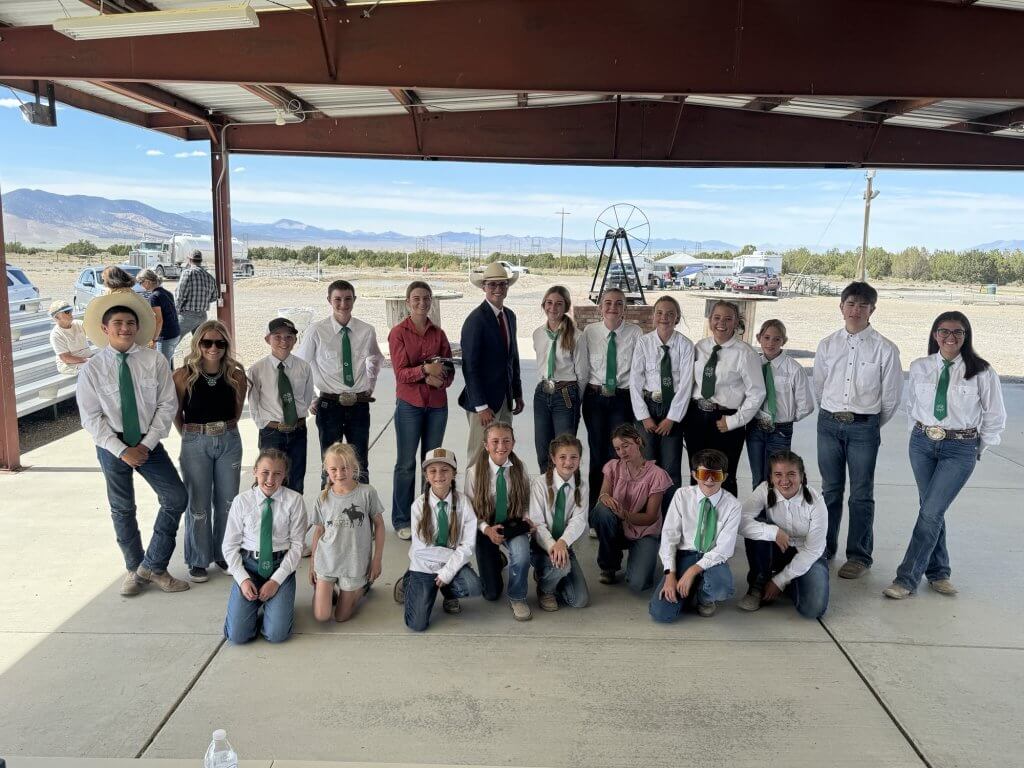
Group photo from Mustang Camp this past year.
In Nevada, 4-H is administered by the University of Nevada Extension. By matching educational experiences with local needs, the program helps youth develop self-reliance and technical expertise. In Eureka County, that effort is spearheaded by 4-H coordinator Tosha Kerby.
Kerby is a 4-H “lifer.” She grew up in the program in Moab, Utah, and served as a “4-H mom” in Eureka County from 2017 to 2020. She stepped into the coordinator role in March 2020. Despite the challenges of taking the reins during a global pandemic, Kerby is encouraged about the program’s future and remains focused on expanding its reach.
The livestock program remains a cornerstone of Eureka 4-H, offering youth the chance to raise an animal from start to finish. This rigorous, months-long process culminates in the annual market at the county fair, but the real value lies in the development of the participants. Through this program, youth gain vital business acumen by managing costs, learn deep responsibility through daily animal husbandry and build determination as they master the “showmanship” required to present their animals to judges.
To better support local participants, the fair recently shifted to a local-only entry format. This change ensures more room for Eureka County youth — ranging from “Cloverbuds” as young as five to young adults up to age 19 — to participate fully in the tradition.
Another hit is the Shooting Sports program, which currently hosts 14 participants. Beyond marksmanship, the program instills firearm safety and the ethical principles of hunting. Kerby expects these numbers to climb further as more volunteers earn certifications to offer archery and shotgun in addition to rifle and pistol. The local 4-H provides various other smaller activities throughout the year, including summer workshops for both Cloverbuds and older youth. They also assist Juvenile Probation with its STEM camps and took 10 kids to summer camp at Lake Tahoe.
“4-H does offer a ton of different project areas,” Kerby said. “So it’s not limited to just the livestock side of things.”
Despite the success, the program faces a universal challenge: a shortage of mentors. “Volunteerism is truly the backbone of 4-H,” Kerby said, noting that while Eureka County has a dedicated core of volunteers, many are stretched thin across multiple organizations. Because of this, the program is constantly seeking fresh faces to help out.
“We welcome everybody,” Kerby said. “I don’t think there is such a thing as ever enough.”
One common misconception Kerby hopes to clear up is the perceived time commitment. Volunteering with 4-H is designed to be flexible; whether a resident has one hour a month or ten, there is a role for them. Furthermore, the program thrives on diverse talents, and any skill — from coding and cooking to traditional crafts — can be transformed into a valuable workshop for the kids. Even within the more demanding year-round programs like livestock, volunteers are welcome to assist on a schedule that works for them.
“It doesn’t have to be that year-round commitment,” Kerby said. “It can be, you know, just a few hours here and there, and we would love that.”
The 4-H coordinator credits the success of 4-H to the unique synergy in Eureka County. Rather than competing for resources, local organizations work together for the common good. 4-H maintains strong relationships with the school district and the Juvenile Probation Office (JPO), even assisting the JPO with its STEM camps. Kerby believes this high level of communication is exactly what allows such a small community to provide such robust programming.
“I feel like 4-H does kind of fill in the cracks,” she said, adding that the program is particularly beneficial for youth who may not be as busy with athletics.
For Kerby, the work is personal. The skills she learned in 4-H gave her the confidence to run her family’s ranching operation, and she sees that same confidence blooming in her own children. Her goal is to ensure every child in Eureka County has that same chance. As she puts it, the more residents who step forward to share their unique talents, the more “real-life” experiences the program can offer the next generation.
“I’ve seen it sprinkled throughout my life, of things that I have learned in 4-H that I’ve used, you know, throughout life, public speaking, being able to have conversations, all of that,” she said.
How to get involved
Those interested in volunteering or enrolling a child in 4-H, contact Tosha Kerby at the University of Nevada Extension office in Eureka at 775- 237-6135 or at tkerby@unr.edu.
Leave a Reply