 HOME
HOME BUSINESS DIRECTORY
 CLASSIFIEDS
 CALENDAR

 NEWS
NEWS SPORTS
 OPINION
 OBITUARIES


In a standing-room-only meeting of the Crescent Valley Town Advisory Board, representatives from Nevada Gold Mines (NGM) presented a proposal on Wednesday, March 18, to replace a fleet of over-the-road trucks with a 55-mile common carrier rail line.
The project, estimated to cost $500 million, aims to transport gold ore from the Cortez Mine south of Crescent Valley to the Goldstrike processing facility near Carlin. If approved, the move would alter the industrial landscape of the valley, potentially eliminating up to 80 heavy truck trips through local intersections every day.
A ‘tier one’ solution for growing pains
The presentation was led by NGM Permitting Specialist Luke Barrett and the leadership team including Cortez Mine General Manager Sam Marich. Barrett framed the proposal as a natural evolution of the joint venture between Newmont and Barrick, which has granted the company flexibility in how it processes ore across its twelve Northern Nevada properties.
Currently, ore from Cortez is hauled by truck to the Carlin Complex, where roasters and autoclaves extract the gold.
“We’ve evaluated a private haul road and ‘road trains’ with five or six trailers,” Barrett explained. “But at the end of that evaluation, we determined the safest and most economical way to move that ore is by railroad.”
The proposed “Nevada Gold Rail” would consist of approximately 55 miles of new track divided between two spurs. The line would tie into the Union Pacific (UP) main line near Beowawe, requiring NGM to coordinate its single daily train—typically 50 to 100 cars long—with UP’s existing transcontinental schedule.
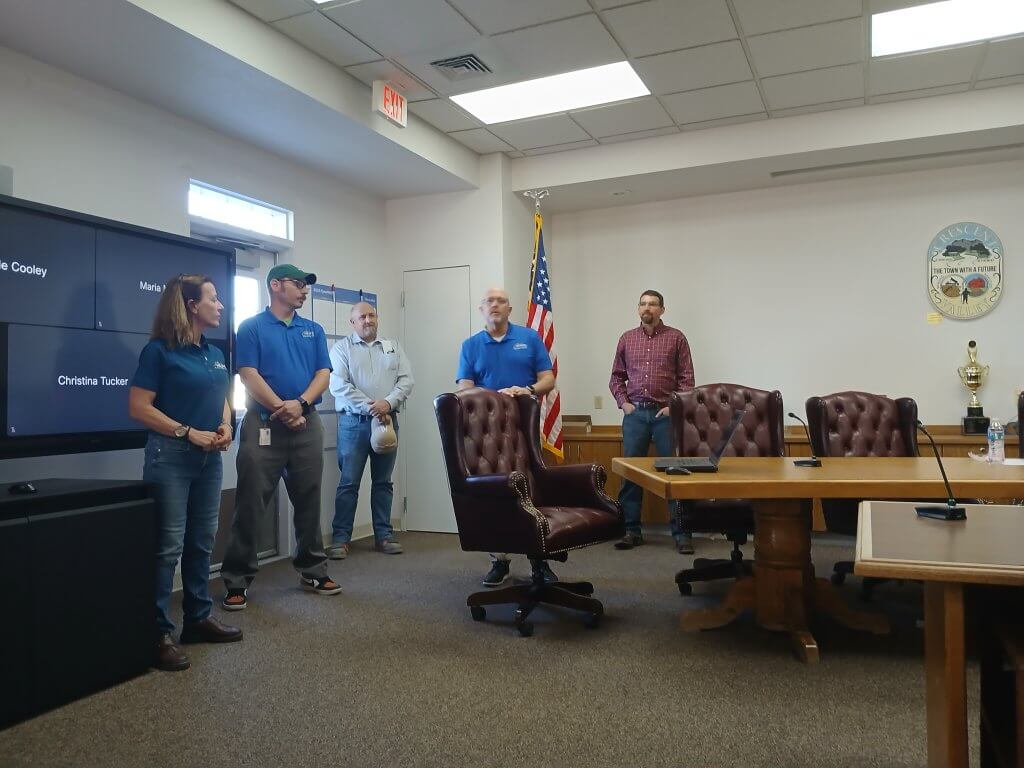
(Left to Right) Jennifer Jonas – Native American and Community Affairs Manager, Matt Miller – Community Engagement and Development Specialist, Sam Marich – General Manager for the Cortez Mine Site, Sam Brown- Community Engagement and Development Specialist and Luke Barrett – Permitting Specialist, Nevada Gold Rail Permitting Lead, meet in Crescent Valley to discuss $500 million rail line concept.
The ‘common carrier’ twist
One of the most significant aspects of the proposal is its designation as a “common carrier” line. NGM needs the new track to be common carrier in order to use the Union Pacific line at Beowawe (a common carrier rail) to bridge the gap between the two rail lines in Crescent Valley and Boulder Valley. Because the new track would be common carrier, the tracks are available for public use, with authorization from the Surface Transportation Board.
“Anyone who wants to ship or receive material via rail would have a legal right to use the proposed new spur,” Barrett told the crowd. This means that if a new business or industry were to set up in Crescent Valley, they could theoretically tie into the rail line. While NGM is primarily building the line to move ore, the common carrier status opens the door for broader regional economic development.
Environmental and safety gains
For many locals, the primary appeal of the rail line is the reduction of highway congestion. Resident Dale Kersey, a veteran of the railroad industry, voiced strong support during the public comment period.
“This is so much safer going rail than truck, it is unbelievable,” Kersey said, noting that the move would eliminate the risk of fatal collisions with mine trucks and the constant barrage of road debris that currently shatters windshields along the route.
Beyond safety, NGM highlighted several “ancillary benefits,” including:
- Carbon reduction: Rail transport is significantly more energy-efficient than trucking, leading to lower overall emissions.
- Extended mine life: By reducing transportation costs, lower-grade ore becomes economically viable to process, potentially extending the life of the Cortez Mine well into the 2050s.
- Noise mitigation: The preferred alignment keeps the tracks on the east side of the valley, utilizing NGM-owned land to minimize vibration and noise impacts on the Crescent Valley township.
The regulatory long game
Despite the optimism, officials cautioned that the first train is still years away. The project must undergo a rigorous National Environmental Policy Act (NEPA) review overseen by the Surface Transportation Board (STB) and requiring significant involvement with the Bureau of Land Management (BLM) as a cooperating agency.
“We anticipate about a two-year permitting process, followed by at least two years of construction,” Barrett said. “It would be a bare minimum of four years before it would be an operating rail.”
Environmental Permitting Manager Tamara Baker added a note of corporate realism, reminding attendees that in the volatile world of gold mining, plans can shift. While the rail line is currently the “preferred” option, NGM is simultaneously studying the possibility of building a new processing facility directly at Cortez.
“In two years, we could come up with a better plan,” Baker said. “It’s NGM’s obligation to shareholders to do what’s best for the company.”
Community coordination
The meeting also touched on local infrastructure. Angie Negro raised concerns about the impact on Ormat’s new geothermal plant. Barrett acknowledged that the rail line would involve approximately eleven crossings with traffic control, including the road used by Ormat, and promised further coordination as the engineering plans are refined.
Eureka County Natural Resource Manager Jake Tibbitts, attending via telelink, noted that the County Commission will be closely monitoring the project. He directed residents to the county’s online parcel finder to view the proposed alignments in detail.
As the meeting concluded, the consensus among the standing-room crowd appeared to be one of cautious interest. While the $500 million price tag is large, the promise of quieter roads and a longer-lasting mine seems to have struck a chord.
The Surface Transportation Board is expected to launch a dedicated project website soon, where the public can view detailed maps and submit formal comments as the federal review process begins.
Leave a Reply