 HOME
HOME BUSINESS DIRECTORY
 CLASSIFIEDS
 CALENDAR

 NEWS
NEWS SPORTS
 OPINION
 OBITUARIES


By Justin Pollack
On Aug. 25, 2015, under Order 1264, the Nevada State Engineer declared the Diamond Valley hydrographic basin Nevada’s first and only Critical Management Area (CMA), shaking up conventional water law. The designation as a CMA gave local water rights holders 10 years to develop a Groundwater Management Plan which, upon completion, would have to be presented to the state engineer for approval.
This drastic measure was taken since Diamond Valley’s water resources are some of the most over appropriated in the nation, with the state engineer determining the hydrographic basin has had a decline of roughly two feet per year since 1960, resulting in drops of over 100 feet of water level in the most over-drawn sections of the valley.
Pumped groundwater, a coveted resource in the driest state in the US, is primarily allocated towards irrigation for Diamond Valley’s renowned hay and alfalfa crop; it also serves domestic, mining, commercial and industrial needs in the area. A slew of environmental factors make Diamond Valley an ideal location to farm high-quality alfalfa, generating tens of millions of dollars each year.
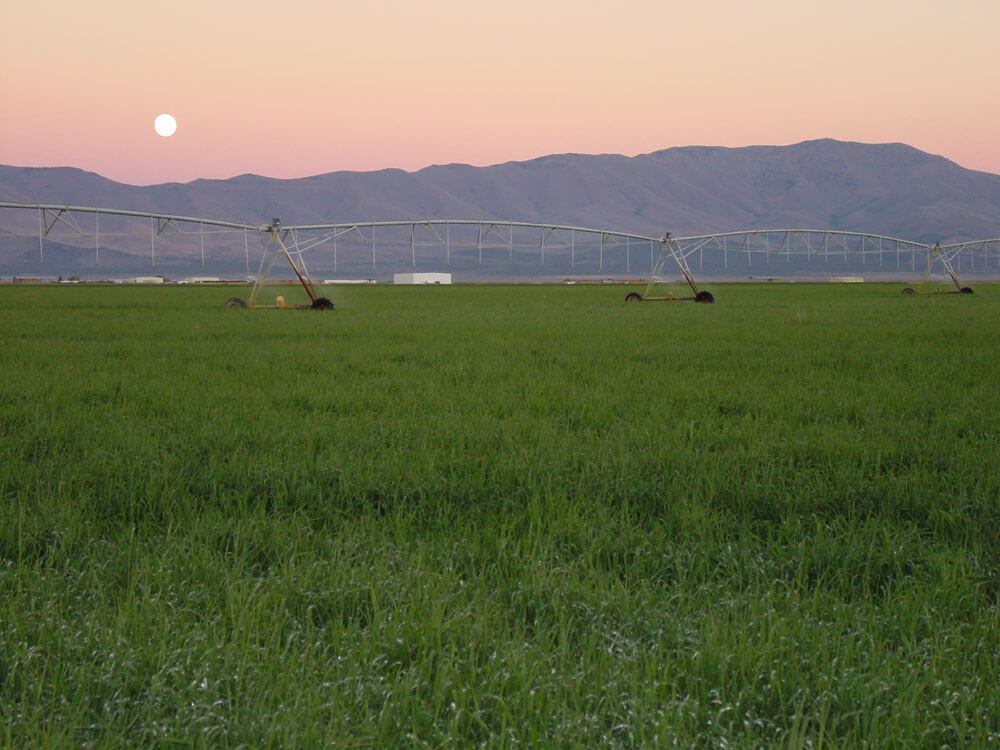
A field in Diamond Valley. The valley’s water resources are some of the most over appropriated in the nation
The perennial yield, or the maximum amount of groundwater that can be extracted each year over a long term without depleting the valley’s groundwater capacity, is 30,000 acre-feet per year.
Despite this, according to a report from Great Basin Resource Watch, about 126,000 acre-feet per year of irrigation groundwater rights are permitted. In 2016, about 76,000 acre-feet of those permitted rights were pumped. This imbalance between available and allocated water has resulted in severe overdrafts and continuously declining water levels.
As a result of the CMA designation, a plan signed by 257 water rights holders in Diamond Valley was presented to the state engineer in August 2018, which was approved and instated through Order 1302 on Jan. 11, 2019. This enacted the Diamond Valley Groundwater Management Plan (DVGMP), the first of its kind in Nevada’s state history.
Those with claims filed before May 12, 1960 are considered senior water rights holders, while those who filed after that date are categorized as junior water rights holders. The controversial nature of the GMP that set a new precedent is that the doctrine of prior appropriation is disregarded, as reductions to pumping are being imposed on both junior and senior water rights holders.
In April 2020, a Eureka District Court submitted Order 1302 for judicial review, as the DVGMP required reductions from water rights holders regardless of the “first in time, first in right” principle. Despite this deviation from existing state water law, on June 16, 2022, the Nevada Supreme Court reinstated the DVGMP, and alongside this, declared that 2023 would be treated as the second year of the plan.
Domestic water allocation, which makes up approximately 4 percent of groundwater rights within the basin, is not within the DVGMP’s jurisdiction, so cutbacks on water won’t affect household use; however, the GMP still affects farmers’ livelihoods as much of Eureka County’s economy is based on agriculture and water resource availability, which will continue to shape the future of agriculture and industry in Diamond Valley.
So far, measures taken under the DVGMP have been seemingly effective in making progress to achieve sustainable groundwater use.
“Water conservation through improved irrigation practices really is paying off in Diamond Valley,” said Jake Tibbitts, Eureka County’s Natural Resource Manager.
Tibbitts plays an integral role in Eureka County’s groundwater management and has actively worked to balance the demands of the state with the needs of local farmers. He’s been instrumental in helping Eureka County farmers make required adjustments while also monitoring its progress.
“The pumping [rate] last year, with some help from precipitation from Mother Nature, was many years ahead under the GMP,” Tibbitts said. “We have also seen positive responses to the groundwater levels because of pumping reductions, proof that the GMP is working to stabilize water levels.”
However, local farmers are faced with a future of uncertainty as the plan sets a completely new precedent for water resource management. Reductions in groundwater pumping threaten their livelihoods, which depend entirely on having enough water to grow alfalfa and hay.
“My water right has been reduced without compensation and without regard to Nevada and Western water law of First in time first in right,” said Laurel Marshall, a farmer in Diamond Valley.
With reductions in groundwater pumping being an inevitable part of the future, many farmers are also being forced to adjust their agricultural practices. Many have chosen to implement Low Elevation Spray Application (LESA) technology, which places more sprinklers with lower water pressure closer to the ground on center pivots, thus reducing energy and water consumption while maximizing crop growth.
“Around four-fifths of Diamond Valley farmers have already implemented LESA irrigation systems on their pivots, increasing their irrigation efficiency by up to 80 percent,” said Gary McCuin, UNR’s Eureka County Agricultural Extension Advisor. “Soil moisture meters could also improve efficiency by keeping soil moisture in the root zone, yet farmers are probably approaching the greatest efficiency they can without changing crops.”
With reductions in groundwater pumping being gradual, farmers in Diamond Valley have time to adapt to restrictions, yet the DVGMP foreshadows the future of an increasingly water-scarce American mountain west.
If, by Oct. 1, 2033, the state engineer determines that the GMP has not made significant progress, then the “state engineer is required to dissolve the GMP,” said Tibbitts, “which means all ‘junior’ groundwater rights in Diamond Valley would not be able to pump any more water.”
Leave a Reply