 HOME
HOME BUSINESS DIRECTORY
 CLASSIFIEDS
 CALENDAR

 NEWS
NEWS SPORTS
 OPINION
 OBITUARIES


By Garney Damele
Eureka County may be renowned for its gold, but its alfalfa, hay and water can be considered just as valuable.
Diamond Valley, sitting in the southern end of the county, is known for producing high-quality alfalfa and timothy hay, attracting growers and buyers to the area. Its premium hay is shipped across the U.S. and abroad, notably to horse farms in the east and dairy farms in California.
“It’s the altitude that produces the quality,” said longtime hay buyer Jim Petteys. “The high elevation, cold nights and hot summer days create a product that can’t be found in the east.”
In 2025, Petteys bought and shipped about 90,000 bales from Diamond Valley, mostly for high-end horse owners in Florida, but also Kentucky and New York.
Diamond Valley has nearly 26,000 acres under irrigation. It didn’t take long for the valley to find that its water source, a large underground aquifer, was overused. According to the state water engineer, the aquifer has been declining at an alarming rate of roughly two feet per year since 1960.
Local producers, long aware of the situation, began working on a plan to solve the problem decades ago. In 2015, the Nevada State Engineer declared Diamond Valley Nevada’s first and only critical management area (CMA).
By statute, this designation provided a 10-year period for the groundwater rights holders to develop a groundwater management plan (GMP). Sixty percent of the stakeholders (water-right holders) approved the plan, then sent it to the state engineer in January 2019.
“The foundation for such a plan was laid many years earlier,” said Jake Tibbitts, Eureka County natural resources manager. “Producers, aware that Diamond Valley was over-allocated, began looking into ways to retire groundwater rights back in the 1990s with General Moly Trust.”
The plan bypassed Nevada’s longstanding First in Time, First in Use doctrine, which grants senior water rights holders priority over junior holders—a system consistently upheld by Nevada courts. This prioritization ensures seniors receive water before juniors during scarcity.
The GMP, which was upheld by the Nevada Supreme Court after protests, was made into law in 2022 after reversing a lower court’s decision. It aims to reduce the amount of water pumped from the aquifer from 76,000-acre-feet per year (the amount of acre-feet of water pumped in Diamond Valley in 2016), to 34,200 acre-feet per year by 2056.
All water users have had their permitted water reduced. In the plan’s first year, a priority factor based on seniority determined each permit holder’s shares. This, now factored share amount, is further given a significant initial reduction of 33% (a factor of .67) across the board; this is the first year’s allocated amount of water a farmer can utilize. For the next 34 years, the allocated amount of water will decrease by about 3% on average annually.
“The plan regulates and tracks water use of every pivot in the valley with the goal to quickly get water off the books,” noted Tibbitts. “The goal is to eventually reach the perennial yield and the water stabilizes.”
The perennial yield is the amount of groundwater that can be extracted each year over the long term without depleting the valley’s groundwater capacity. For Diamond Valley the perennial yield is 30,000 acre-feet per year, according to the state water engineer.
According to Tibbitts, the plan is working; based on data collected since the inception of the plan four years ago, the amount of water pumped has been steadily decreasing.
“In 2024 the plan allowed 68,400 acre-feet of water to be pumped, and the actual numbers show that 55,444 acre-feet were pumped,” he said. In 2025 the valley pumped 55,000 acre-feet, as reported at the annual water meeting in December.
The GMP is limited to the regulation of irrigation wells, although groundwater sourced from Diamond Valley additionally serves domestic wells, two general improvement districts, stock water needs and mining activities, including dewatering operations.
But how do growers keep farming with shrinking water supplies in the nation’s driest state, which gets just 9.5” of rain each year?
Many farmers, including Jim Gallagher of Diamond Valley, have had to change how they farm. “We have to reduce our pumping by efficiency,” he said.
Growing three crops of alfalfa each year, which is average for Diamond Valley, requires anywhere between 200 and 400 acre-feet of water annually, depending on rainfall. An acre-foot covers one acre with one foot of water.
Gallagher has been farming the valley since 1979. He raises alfalfa and timothy hay with his family on about 750 acres. In 2025 he used, on average, about 280 acre-feet of water on each pivot.
“We want to get to 250 or 260 acre-feet,” he said. “We are four years into the program and still learning a lot,” he added. “(It helps) if you watch what you’re doing and shut the pump off when you don’t need it. It’s a matter of ‘running water versus irrigation’ and we need to learn to irrigate.”
Both Gallagher and Tibbitts cited Marty Plaskett as an example of an effective irrigator.
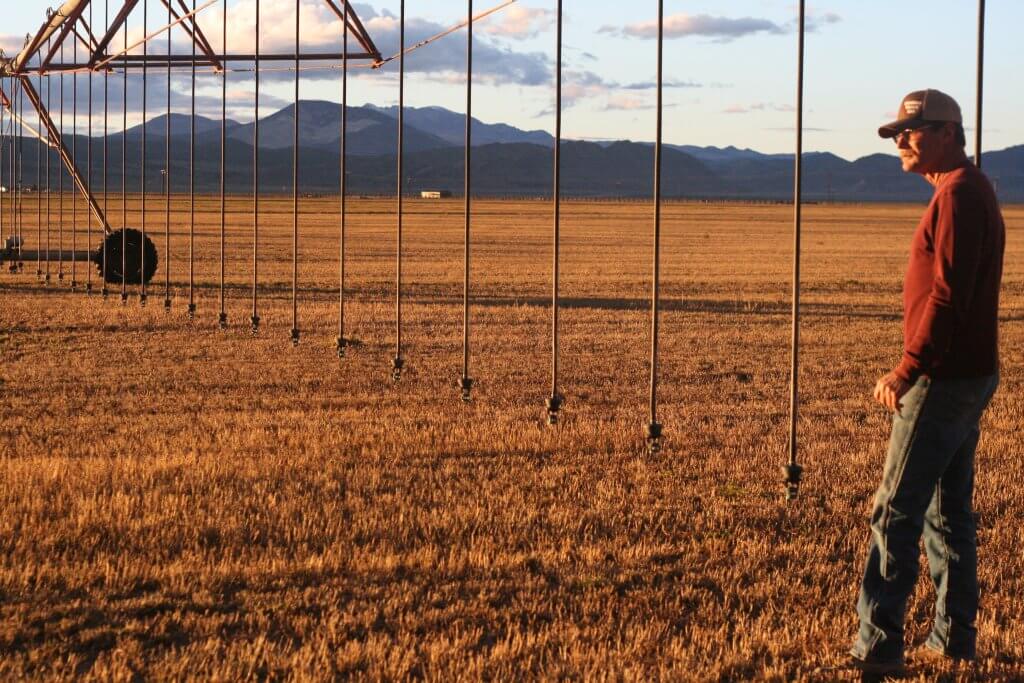
Plaskett owns DV Hay Co. and farms 10 pivots with help from his family. He has embraced low-elevation spray (LESA) systems as a way to efficiently water his crops. This technology includes sprinkler systems which are about one foot above the ground and utilize lower water pressure, thus reducing energy and water consumption while maximizing crop growth.
“We need to stop evaporation due to wind drift, which is water pumped for no gain,” he said. “We need to change management. We used to turn on the pivot and leave it on throughout the season. This is an old-school method. We need to meet the plant needs.”
“From here it’s going to get tighter quicker. We can’t count on Mother Nature to solve our problems. It comes down to creative management decisions. Where do you put the water you have?” he said.
Being creative is something Lynford Miller takes to heart. He and his son farm 1,500 acres of their own and custom hay 2,500 more acres.
The Millers were drawn to Diamond Valley when irrigated land sold for $1,000 per acre 25 years ago. But even as the price of irrigated land has increased over time—Miller’s son purchased a farm for triple the amount he paid—he feels the land is worth it.
“It’s worth a half million, if we have the water,” he said. “A young guy can come here and pay for it by farming. It’s a wonderful place for young guys to get started.”
With 12 pivots of his own, Miller has the space to investigate what works and what doesn’t in Diamond Valley. The family has embraced regenerative farming and rotational grazing practices.
“We are always trying new things,” he said. “We are experimenting.”
This year the Miller’s planted sainfoin, a legume similar to alfalfa. “(Sainfoin) will grow on half the water, takes zero fertilizer, there’s no bloat for cattle and no colic for horses,” he said.
The Millers convert the crop to pellets and sell to high-end retail horses and exotic animals.
They rotate what they plant, so instead of alfalfa one year, they will plant a cover crop, mainly from the brassica family (turnips, kale, radishes, collards, etc.), and then graze it with a small herd of cattle in the fall and winter.
“We can conserve water with diversity,” he added. “We have found other ways to grow. As the water gets less and less, we are going to have to find ways to conserve water.”
Plaskett recognized that a key part of the GMP is being able to set unused water aside for future needs as restrictions become more stringent.
Banking water sets the GMP apart from traditional western water law by introducing a market-based system for selling, leasing or trading water rights. While Nevada allows water rights transfers, Nevada law requires strict legal processes. The GMP bypasses the state engineer’s requirements, opening an avenue that makes moving water easy.
“A transfer is as simple as having two willing parties,” added Tibbitts.
By the end of 2024 nearly 2,500 acre-feet of water were transferred between neighbors or between one pivot to another from water they banked, according to data collected and reported on the 2024 share register that is found on the state engineer’s website. However, actual water never moves, just the ownership held by permit holders.
Banking water was set in place so that, as time goes by and a grower’s allocated water is less, there is water available. This unused water is accumulated year after year. Just a small percentage of this water decreases to account for natural losses.
“It was designed so that you are able to conserve in the early years, so you can bank all that water and then it’s available when you need it,” said Plaskett. “It’s there; it’s my banked water.”
However, some see banking as a means of creating water barons. Anti-speculation doctrine seeks to prevent “hoarding” of water by non-users.
“In a traditional prior appropriation system, beneficial use staves off speculation, but in a water market, many worry that some might stockpile shares to drive up prices,” Ari Erickson, landowner, related in his 2018 letter opposing the plan.
Carolyn Bailey, whose family ranches and farms in the valley, cautioned in a written statement dated November 2018 that banking water could exceed available resources.
“There is no extra water,” she stated. “It’s a paper-shell game. Giving shares to abandon water and banking shares adds to the future demand on the aquifer.”
In 2003, Howard Hill purchased 291 acres located on the eastern edge of the valley. This property included 1,104 acre feet of water rights (shares), yet has not yielded any crops for several decades. Using GMP’s unique feature to hold onto unused water, Hill has stored his water for later. His banked water has nearly doubled to 2,130.578 acre-feet of water by the end of 2024, just four years into the plan, nearly twice the amount of his shares. Hill can use this banked water, sell it, retain it or lease it, according to the plan.
“I’ve been contacted by at least five different people to buy my water,” Hill said. “I’m holding onto it. Hopefully I’ll be able to do something with it myself. The land is not worth anything without water, and I’m not interested in selling my water.”
Another unique aspect of the GMP is that it requires all water-rights holders, regardless of seniority, to share in the reduction of pumping.
“Under the law, they (state engineer) can take it from you,” noted Tibbitts. “The GMP changes this. (Now) it’s kind of like a shared sacrifice,” he said.
Petteys, who lives in Utah and has a distribution center and retail store in Florida, where he ships hay to, notes that some hay growers have been in the valley for a long time but weren’t given preference for their senior water rights.
“I think somewhere down the road it’s going to cause a problem, as it sets a precedent,” Petteys said.
“My water right has been reduced without compensation and without regard to Nevada and Western water law of first in time, first in right,” noted Laurel Marshall, a farmer and senior water-right holder in the valley.
In 2024 grant money from President Biden’s American Rescue Plan Act (ARPA) was used to retire water rights in the valley which many viewed as another avenue to help meet the goals of the GMP. This program provided $9.6 million to the Central Nevada Water Authority, which in turn developed a plan to acquire water rights from Diamond Valley farmers willing to sell and retire their water rights.
According to Tibbitts, this initiative permanently retired 11,341 acre-feet of water and took 26 irrigation wells out of operation. Sellers retired only their water rights, not their land, receiving $850 per acre-foot; $50 is to be used for mitigation efforts like weed and rodent control.
“Pumping would likely have been more if not for retirement of some irrigation rights,” Dale Bugenig, consulting hydrogeologist, reported to growers at their annual water meeting in December, referring to the 2025 data.
Some note that water pumped in 2025 (55,000) was nearly unchanged from 2024 (55,400), the year of the buy-out program.
And according to the state engineer’s 2024 share register, the amount of actual water pumped from the wells that were retired with the buyout plan amounted to only 3,506 acre-feet in 2024—well below the 11,341 water-right duty of those water permits retired.
“Water was being bought from ground that hasn’t been farmed…How’s that conserving water? I cannot see how that will help the situation,” said Petteys.
Petteys thinks the plan, along with tighter control of water use, has contributed to lower-quality hay and decreased productivity.
“I’ve seen it across the valley. It’s not every pivot, but overall, the water is being stretched too thin, the crops are not as productive, the quality is not as good,” he said.
But he admits that there is an issue that needs to be addressed. “I see the future having less owners, less pivots. It’s going to have to be that way or else no one will be farming,” he said.
“When the water stabilizes, we will no longer have to give up water,” Tibbitts said.
Added Plaskett, “It’s a pretty unique plan…It was set up so that the valley remains intact.”
Leave a Reply